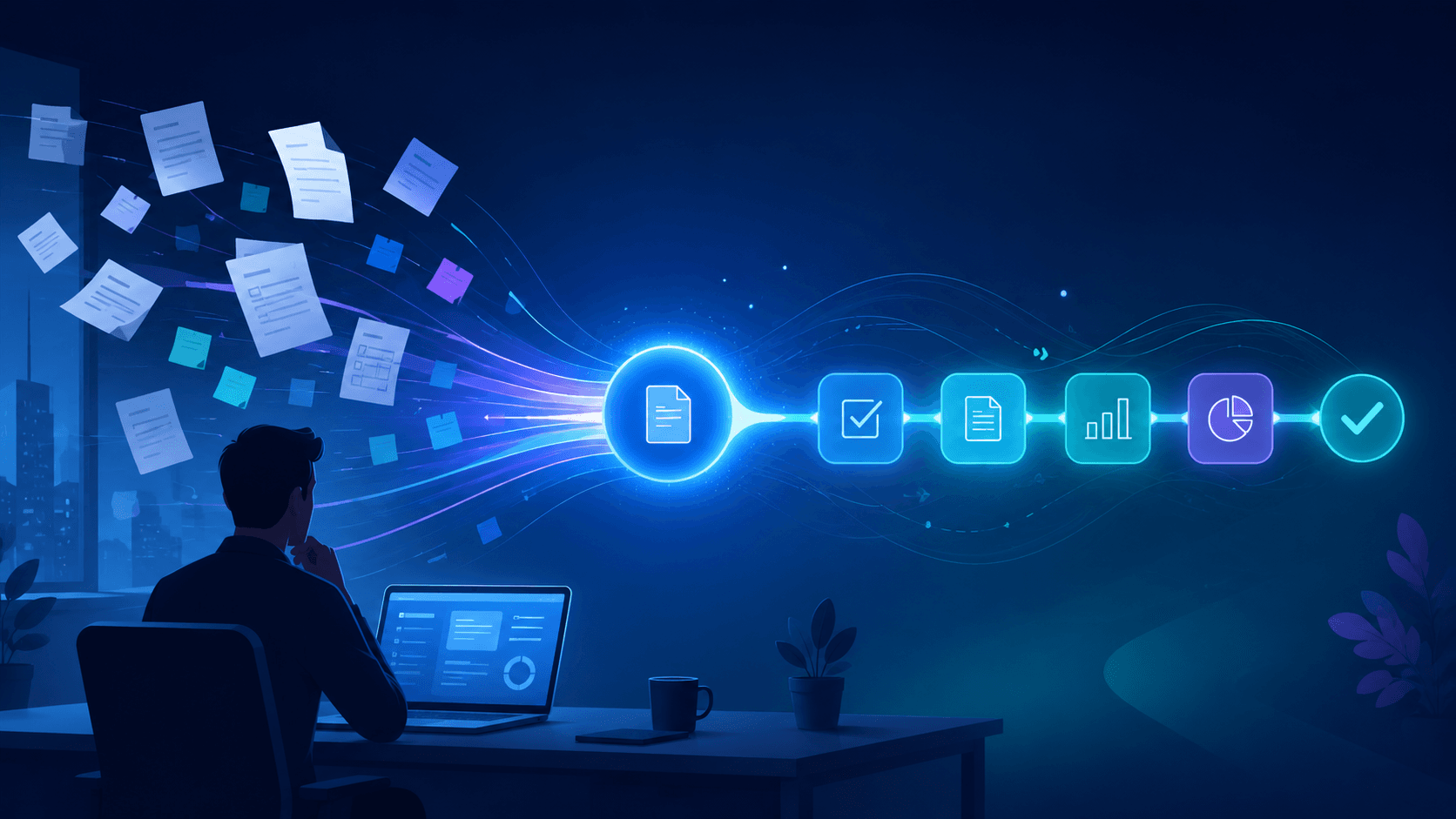
AI workflow automation reduces manual work by taking over the repetitive, rule-based steps inside a process — data entry, routing, status updates, follow-ups, document checks — and running them consistently without a person doing each one by hand.
What kinds of work can be automated?
The best early candidates are tasks that are frequent, rule-driven and low-judgement. Approvals that follow a fixed policy. Updates copied between systems. Notifications triggered by an event. These are where automation removes effort without removing human control.
Where does the AI part come in?
Plain automation handles fixed rules. AI extends it to work that involves a little interpretation — reading an unstructured email, classifying a request, summarising a document — so more of the workflow can run end to end before a person needs to step in.
- Less double-handling between systems
- Fewer errors from manual copying
- Consistent outputs every time
- Capacity redirected to higher-value work
AI workflow automation removes the repetitive, rule-based steps in a process and uses AI for the lightly interpretive ones, so teams spend less time on administration and more on judgement. Start with frequent, low-judgement tasks.
Published 8 May 2026 · Updated 8 May 2026